How Film and Humour Are Changing the Death Conversation?
1st June 2026

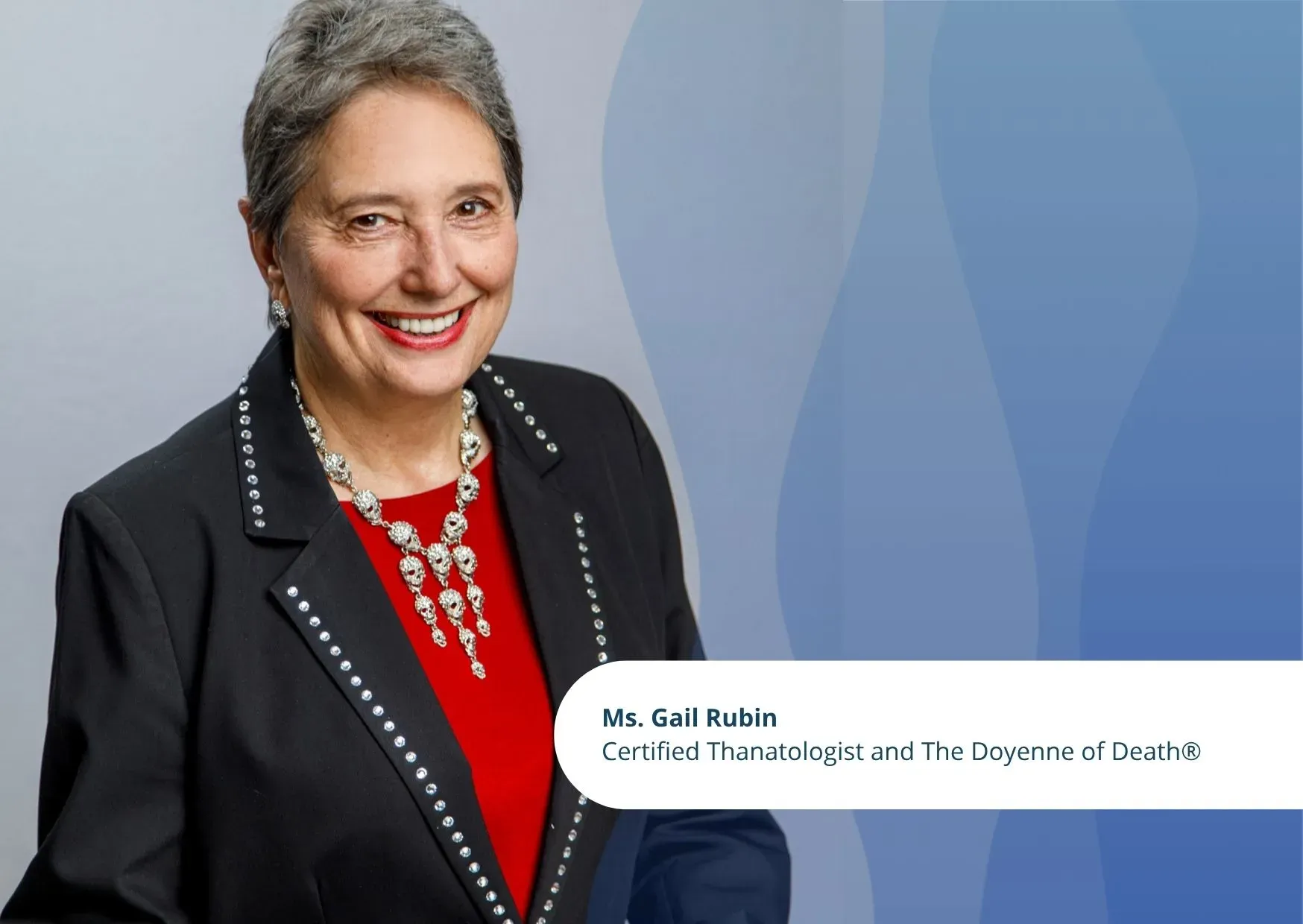
Death remains one of the last great social taboos, even in a world increasingly open to discussing once-sensitive topics. Gail Rubin, Certified Thanatologist and widely known as The Doyenne of Death®, has built her career around changing that reality. By combining death education with film, storytelling, and humour, she helps people approach mortality with curiosity rather than fear. In this Q&A, she reflects on how cinema shapes society’s understanding of death, why humour can coexist with respect, and what funeral professionals can learn from the emotional language of film as they support families navigating one of life’s most difficult transitions.
Katarzyna Supa: Your career combines death education with film and humour. In your view, does death still remain a taboo subject?
Gail Rubin: Absolutely. Death is still the guest no one wants to invite to the party, even though it is guaranteed to show up eventually. We are more comfortable talking about sex, money, and even politics than we are about dying. My motto is, “Talking about sex won’t make you pregnant, and talking about funerals won’t make you dead.”
Bit by bit, the taboo is cracking. People are curious, hungry even, for honest conversations about mortality. As a pioneer of the Death Café movement in the United States in 2012, I noticed mostly women participated. When mortality conversations were paired with Movie Nights, more men attended and joined in the discussion.
Humour and film help sneak death into the room without everyone bolting for the exits. When people are laughing or absorbed in a story, they lower their defences. With Mortality Movies, suddenly, the “D-word” (DEATH) is not so scary. Research suggests people remember information from a video scene significantly better than from listening alone.
K.S.: What led you to use films as such a powerful tool for conversations about death and grief? Your book looks at 142 films and television shows addressing mortality. Which five would you consider a must-watch for everyone?
G.R.: In college, I majored in communications and film. I studied classic directors, genres, and film production. One project parodied Ingmar Bergman’s landmark film, The Seventh Seal. The Grim Reaper and the Knight used bubble-gum fortunes in place of chess. Death still won. That project predicted my future in death education using humour and films.
Movies are empathy machines. You can live a thousand lives, and die a thousand deaths, just sitting in the dark with popcorn. Films let us explore grief, fear, love, regret, and legacy safely from our seats. Long before I was a death educator, I was a movie lover, and I noticed how often death showed up as the emotional engine of great storytelling.
Choosing only five films about mortality is like choosing five favourite stars in the sky, but here are my must-watch picks:
“Defending Your Life” – A comedic afterlife fantasy that helps us ponder how we live our best lives, as one man’s most recent incarnation gets reviewed in the afterlife setting of Judgement City.
“Gravity” – A sci-fi thriller disaster film that provides profound insights on grief and the messiness of moving forward in life.
“Coco” – An animated film with joyful, colourful lessons about Dia de los Muertos and the importance of remembering our ancestors and correcting mistakes of the past.
“Departures” – An Oscar-winning film from Japan that provides a beautiful, respectful look at funeral ritual and the dignity of caring for the dead.
“Wit” – Unflinching, compassionate, and essential for understanding end-of-life care and empathy.
If everyone watched just those five, we would have much better dinner conversations and probably better deaths.
K.S: How has the portrayal of death in films evolved over the past decades? Have you noticed any trends, greater openness, or shifts in the topics being explored? To what extent does cinema distort the realities of funerals, procedures, or grieving, and what are the biggest myths audiences might take away?
G.R.: We have come a long way from death as either slapstick or melodrama. Today’s films are more nuanced. We are seeing quieter deaths, complicated grief, and stories that do not wrap everything up with a neat bow. There is more openness about hospice, dementia, suicide, medical aid in dying, and unfinished relationships.
That said, cinema still lies, a lot. Funerals are unrealistically elegant, bodies always look peaceful, and grief has a suspiciously short shelf life. One of the biggest myths is that grief is linear and has a time limit. Movies love a three-act structure. Grief does not. Another myth is that one profound speech or emotional breakthrough fixes everything. Real grief is more like a long, winding series with surprise plot twists. There’s a curated list of 19 films that specifically address grief and growth in my upcoming book, 98.6 Mortality Movies to See Before You Die.
K.S: Your work includes Death Cafes, Before I Die Festivals, and Mortality Movie Nights. Are there particular motifs or symbols of death in films that inspire you in your educational work and that could be valuable for funeral professionals?
G.R.: Absolutely. Journeys are huge. Films like Bonneville (2006), Elizabethtown (2005), and Around the Bend (2004) feature ash scattering road trips. The Way (2010) features a father hiking along the Camino de Santiago while scattering his son’s ashes. Life is a journey, and death is our final destination.
Cemeteries and gravestones are powerful devices that prompt changes. Think of Scrooge confronting his own grave in A Christmas Carol or George Bailey seeing the alternative future of his younger brother’s grave in It’s a Wonderful Life.
For funeral professionals, movies offer a reminder that families are storytelling creatures. They want meaning, personalization, and moments that feel authentic. Cinema shows us that symbols like candles, photos, music, and even food can hold enormous emotional power. You do not need grand gestures. You need thoughtful ones.
My new book 98.6 Mortality Movies to See Before You Die grew out of my love of movies and my not-so-secret mission to get people talking about death before the Grim Reaper comes to call. The title is a wink to normal body temperature and a reminder that mortality is part of everyday life, not just something that shows up in emergencies. The book curates 142 films and television programs that open emotional and meaningful conversations about dying, funerals, grief, legacy, and remembrance, without requiring anyone to sit through a lecture or have a personal loss to participate. Each entry includes mortality themes and six discussion prompts.
For funeral homes, hosting movie nights based on these films is a powerful, low-pressure way to welcome people into their space while everyone is still alive and curious. Movie nights transform funeral homes from places people avoid into community gathering spots for conversation, connection, and education. It is outreach without awkward sales pitches, education without grief as the entry fee, and relationship-building long before services are needed. Plus, popcorn and chocolate help generate good vibes.
K.S: Looking at the evolution of films, media, and end-of-life education, what do you see as the key areas in which the funeral industry should develop expertise to better meet societal needs?
G.R.: First, communication skills. Not just being nice, but truly listening and guiding families through overwhelming choices. Second, cultural and spiritual fluency. Families are more diverse, less religious, and more creative than ever. Third, comfort with starting advance planning conversations with the public. This is where Mortality Movies can help. People want agency, but many need help starting the conversation before there is a crisis.
And finally, do not underestimate the value of humour and humanity. The funeral industry does not need to be gloomy to be respectful. Films teach us that laughter and tears often sit right next to each other.
K.S: How do you envision the portrayal of death in film and television evolving in the coming years, particularly in terms of education and raising public awareness about end-of-life planning?
G.R.: I think we will see even more realism and more curiosity. Stories about assisted dying, green burial, caregiving burnout, and legacy planning are already emerging. Streaming platforms allow for longer, deeper storytelling, which is perfect for exploring end-of-life complexity.
My hope is that film and television will continue to normalize conversations about dying the same way they have normalized therapy, mental health, and complicated families. If people see characters planning their deaths with intention and love rather than fear, it opens the door for viewers to do the same. And if that happens, cinema will not just entertain us. It might actually help us die better.
Share this article